- Home
- →
- Faculty of Applied Science
- →
- Research Papers
- →
- Department of Physical Science
- →
- View Item
JavaScript is disabled for your browser. Some features of this site may not work without it.
| dc.contributor.author | Thirukumaran, S. | |
| dc.contributor.author | Hoole, S.R.H. S.R.H. | |
| dc.contributor.author | Hoole, P.R.P. | |
| dc.contributor.author | Harikrishnan, R. | |
| dc.contributor.author | Jeevan, K. | |
| dc.contributor.author | Pirapaharan, K. | |
| dc.date.accessioned | 2026-01-22T09:17:43Z | |
| dc.date.available | 2026-01-22T09:17:43Z | |
| dc.date.issued | 2014 | |
| dc.identifier.uri | http://drr.vau.ac.lk/handle/123456789/1731 | |
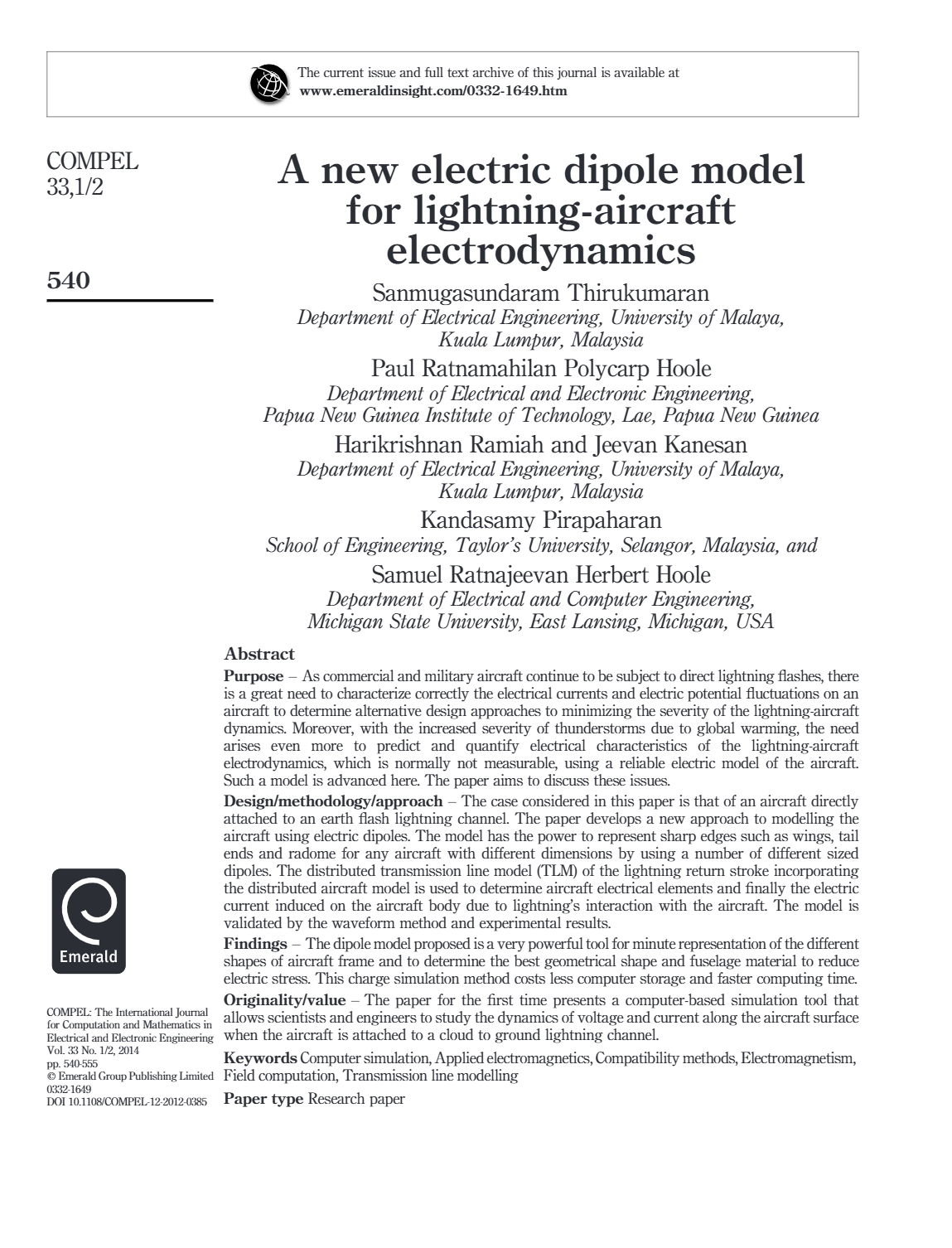
| dc.description.abstract | As commercial and military aircraft continue to be subject to direct lightning flashes, there is a great need to characterize correctly the electrical currents and electric potential fluctuations on an aircraft to determine alternative design approaches to minimizing the severity of the lightning-aircraft dynamics. Moreover, with the increased severity of thunderstorms due to global warming, the need arises even more to predict and quantify electrical characteristics of the lightning-aircraft electrodynamics, which is normally not measurable, using a reliable electric model of the aircraft. Such a model is advanced here. The paper aims to discuss these issues. Design/methodology/approach – The case considered in this paper is that of an aircraft directly attached to an earth flash lightning channel. The paper develops a new approach to modelling the aircraft using electric dipoles. The model has the power to represent sharp edges such as wings, tail ends and radome for any aircraft with different dimensions by using a number of different sized dipoles. The distributed transmission line model (TLM) of the lightning return stroke incorporating the distributed aircraft model is used to determine aircraft electrical elements and finally the electric current induced on the aircraft body due to lightning's interaction with the aircraft. The model is validated by the waveform method and experimental results. Findings – The dipole model proposed is a very powerful tool for minute representation of the different shapes of aircraft frame and to determine the best geometrical shape and fuselage material to reduce electric stress. This charge simulation method costs less computer storage and faster computing time. Originality/value – The paper for the first time presents a computer-based simulation tool that allows scientists and engineers to study the dynamics of voltage and current along the aircraft surface when the aircraft is attached to a cloud to ground lightning channel. | en_US |
| dc.language.iso | en | en_US |
| dc.publisher | Emerald Group Publishing Limited | en_US |
| dc.source.uri | https://doi.org/10.3233/JAE-140 | en_US |
| dc.subject | Computer simulation | en_US |
| dc.subject | Applied electromagnetics | en_US |
| dc.subject | Compatibility methods | en_US |
| dc.subject | Electromagnetism | en_US |
| dc.subject | Field computation | en_US |
| dc.subject | Transmission line modelling | en_US |
| dc.title | A New Electric Dipole Model for Lightning-Aircraft Electrodynamics | en_US |
| dc.type | Journal article | en_US |
| dc.identifier.doi | 10.1108/COMPEL-12-2012-0385 | en_US |
| dc.identifier.journal | The international journal for computation and mathematics in electrical and electronic engineering | en_US |